
A Large File Lands on a Very Old Argument
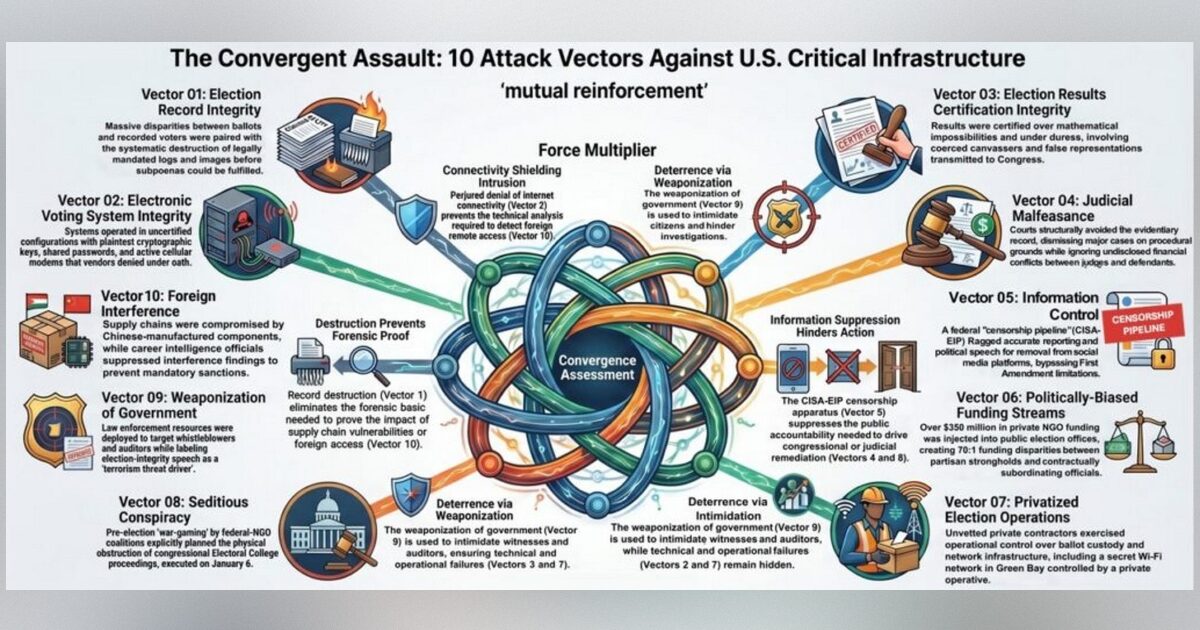
A newly released 799-page report titled An Attack Upon U.S. Critical Infrastructure claims to document problems tied to the 2020 election and related election systems. The report says it contains 824 findings, including 553 described as established facts, 155 described as disputed facts, and 116 described as reasonable inferences. It also lists 18 recommended election investigations and references eight search warrants. That is a lot of paper for a topic much of the press has treated like a suspicious smell in the break room, best ignored until someone else opens a window.
What the Report Says It Used
The authors say their work is based on forensic analyses, sworn legislative testimony, court filings, inspector general investigations, vendor invoices, open-source intelligence, and government communications obtained through litigation and public records requests. The full document is organized into nine sections, followed by an appendix with detailed findings and sources. A shorter executive summary is also available. The report’s central claim is not modest: it argues that election weaknesses touched multiple states and involved activity linked to foreign nations. As always, claims in a report are not convictions, but documents, records, and sworn testimony are not exactly fairy dust either.
Vendors, Agencies, and the Critical Infrastructure Label
The report names several entities, including Runbeck Election Services, Elections Group LLC, the Georgia Secretary of State’s office, Tyler Technologies, the Associated Press, and others. Being named in a report is not proof of wrongdoing, and serious allegations deserve serious review, not cable-news chanting. The report leans heavily on the fact that U.S. elections were designated critical infrastructure in 2017, placing them among sectors considered vital to national security, economic security, public health, and safety. That label matters because if elections are critical infrastructure, then sloppy oversight is not just a paperwork problem. It is a locked-front-door problem, except the key may be under the mat and the mat may have a vendor contract.
Fulton County Remote Access Claim Gets Attention
One highlighted example comes from page 72, where the report discusses alleged remote access during absentee ballot processing in Fulton County, Georgia. According to the report, a poll worker reported on October 23, 2020, that computers used for absentee ballot processing had been remotely accessed, that another party had control, and that data was deleted. The report says the incident was documented in emails by the chief investigator of the Georgia Secretary of State Investigations Division, but no criminal referral followed. If accurate, that is the sort of claim that should be answered with records, timelines, and responsible officials on the record, not the usual public-sector lullaby of “nothing to see here.”
Foreign Access Claims Raise the Stakes
The report also argues that several layers of the election system had foreign exposure risks. It claims machines contained Chinese components, a data center ran on Huawei equipment, code was maintained in Serbia, and poll worker files were stored on a server in Beijing. It also claims analysts did not place certain Chinese interference concerns in writing for political reasons, while Iran was charged and a sanctions trigger under Executive Order 13848 was not used. These are serious claims. They need verification, context, and official answers. If they are wrong, show the receipts. If they are right, then the public deserves more than another round of bureaucratic fog machine theater.
The Fight Over Certification and Challenges
Another major theme is certification. The report argues that officials in key battleground states certified results despite missing records, legal problems, mathematical concerns, and pressure on canvassers. It also says legal challenges were often squeezed by timing rules, with pre-election claims deemed too early and post-election claims deemed too late. Courts and election officials have rejected many 2020-related claims, and that fact should be stated plainly. But a system that answers every challenge with a procedural trapdoor should not be shocked when voters lose trust. Public confidence is not restored by telling citizens to stop asking questions and admire the laminate on the clipboard.
Colbeck Says Officials Have the Report
Patrick Colbeck, listed as the primary author and chief operating officer of the Election Crime Bureau, said the report has been shared with Justice Department officials and elected leaders. He also argued that the claim that there is “no evidence” of election fraud is itself false because the report compiles evidence the authors believe deserves investigation. The proper test now is not whether one side can shout louder. It is whether state and federal officials will review the documents, explain what is valid, reject what is not, and make the records public where the law allows. Elections should not run on trust-us energy. That fuel has been running low for years.
WE’D LOVE TO HEAR YOUR THOUGHTS! PLEASE COMMENT BELOW.


Leave a Comment